
The average first freeze at DFW Airport lands on November 22. The earliest on record came on October 22, back in 1898. That gap is the whole problem. Most North Texas homeowners start thinking about pipes when a freeze warning shows up on their phone, which is usually two days too late to do anything useful.
Almost everything on the list below takes an afternoon in October and never has to be repeated.
When the first freeze actually arrives here
Two dates are worth knowing. Average first freeze, November 22. Average last freeze, March 12. That is roughly four months where a hard freeze is possible, and in an average season DFW records about thirty days at or below freezing.
The timing is uneven. Most of our freezes land in January, which means the first one in November tends to catch people unprepared, and the worst one usually arrives weeks after everyone has stopped paying attention.
What matters more than the forecast low is how long the cold sits. A 30 degree night that warms by 9am is a different event from three days below freezing with wind. Our bad years are always the long ones.
Why North Texas houses break in a way northern houses do not
A house in Minnesota is built around the assumption of winter. Plumbing runs through heated interior spaces, water lines sit well below a deep frost line, and the basement stays above freezing because the house sits on top of it.
North Texas is built on the opposite assumption. Slab-on-grade foundations dominate here, and because there is no basement and no crawl space to run pipes through, the supply lines commonly go up into the attic and come down through interior walls. Water heaters and HVAC equipment often live up there too.
An unconditioned attic tracks the outside air. When a cold front drops the temperature twenty degrees in a few hours, the attic follows, and the pipes above your ceiling are among the first things in the house to reach freezing. That is also why a break up there does so much damage. Water does not pool on a concrete floor and get mopped up. It comes down through drywall, insulation and light fixtures, across whatever rooms sit underneath.
The other three weak points are the hose bibs on your exterior walls, any pipe running through an uninsulated garage wall, and the irrigation manifold sitting in your front yard.
So the standard national advice to insulate your basement pipes is not wrong. It is just useless here. The checklist for a DFW house is different.
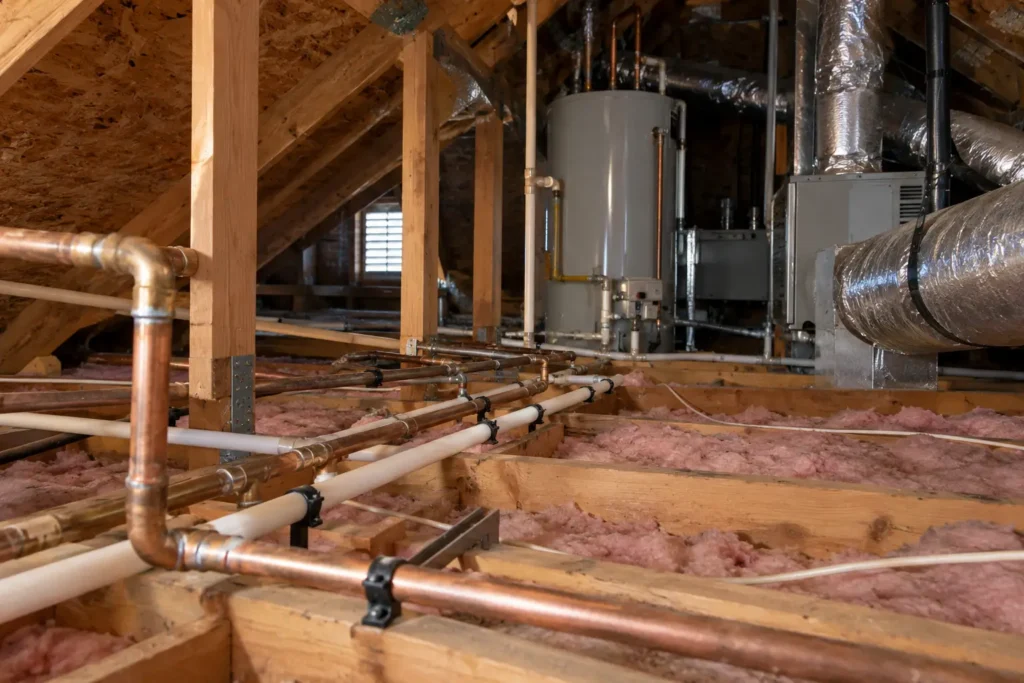
The October list, done once
Find your private shut-off valve and make sure it turns. This is the single most valuable thing on the list. Dallas Water Utilities notes that the private valve is often near an outside faucet close to the house, and on properties with in-ground irrigation it may sit near the irrigation valves closer to the property line. Older homes may have a small iron piece sticking up out of the ground that stops the flow when the handle is turned perpendicular to the pipe. Find it in daylight, confirm it moves, and show whoever else lives in the house. Nobody should be learning this with water coming through the ceiling.
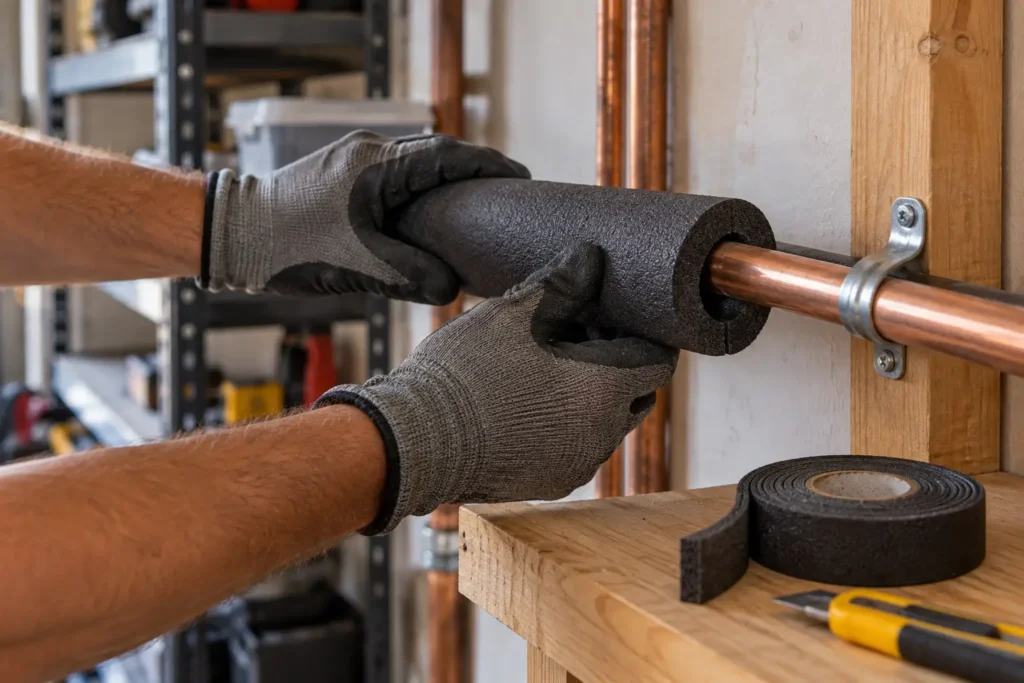
Wrap every exposed pipe, attic included. Foam sleeve insulation costs a few dollars per length at any hardware store on Beltline or Camp Bowie. Cover anything you can see in the attic, the garage, and along exterior walls. Where a pipe is hard to reach, heat tape rated for potable water lines is the alternative, and it needs a working outlet and a label so nobody unplugs it in June.
Disconnect the garden hoses now, not in January. A hose left attached traps water against the spigot, and that is where a lot of DFW breaks start. Pull them off, drain them, store them, and put a hard foam cover or a wrapped cloth over each hose bib.
Look at what else is up in the attic. If your water heater is in the attic, check that the drain pan is clear and that the pan line actually drains outside. People find out those lines are clogged with insulation debris at the worst possible moment. Same with the AC condensate line.
Seal the cold air leaks near pipes. Gaps around dryer vents, plumbing penetrations and garage wall openings let cold air blow straight across a pipe. Caulk and foam close those faster than insulation fixes them.
Insulate under sinks on exterior walls. Kitchen and bathroom sinks that back up to an outside wall are the usual indoor casualties. Insulation in that cabinet wall helps more than opening the doors does, though you will do both later.
Your sprinkler system is the part everyone forgets
An irrigation system is more exposed than your house plumbing. The backflow preventer sits above ground, often unprotected, and it breaks readily.
Shut off the water supply to the system, drain it, and insulate the backflow preventer and any above-ground valves and piping. Insulation sleeves, wrapped cloth under a plastic cover, even a purpose-made bag all work. What does not work is assuming PVC underground is fine. It usually is, but the fittings above grade are not.
One Dallas-specific detail. Freeze sensors on irrigation controllers are required by City of Dallas ordinance, and they keep the controller from running when temperatures drop below freezing. Worth confirming yours is installed and working, because a sprinkler cycle during a freeze turns your driveway and sidewalk into a liability as well as wasting water.
While you are out there, note where the irrigation shut-off sits relative to your main private valve. On a lot of DFW properties they are within a few feet of each other, and knowing both saves time when something is spraying.
The twenty-four hours before a hard freeze
When the National Weather Service puts out a freeze watch, you have a day. Use it on the things that only matter on the night itself.
Bring in the plants and the pets. Disconnect and drain anything you missed in October. Make sure the foam covers on your hose bibs are on tight and the irrigation system is off.
Open the cabinet doors under sinks on exterior walls so warm air reaches the pipes. Leave the thermostat at a steady temperature all night. Setting it back to save a few dollars is how a cold attic wins.
If you have a garage with plumbing on its walls, close the door and keep it closed.
How to drip a faucet properly
Dallas Water Utilities recommends letting hot and cold water drip slowly from faucets during a hard freeze. Moving water is harder to freeze, and an open tap gives pressure somewhere to go if ice does form.
Pick the faucets on exterior walls, and the ones at the far end of the house from where the water enters. Turn on both the hot and the cold side. You want a thin steady stream, about the width of a pencil lead. A single drop every few seconds does very little.
Check them before bed and again in the morning. A drip that quietly stopped at 2am protects nothing.
If you are leaving town
An empty house in a freeze is the worst case, because nobody is there to catch the first leak.
If you will be away for several days, the city’s guidance is straightforward. Turn off the water at your private shut-off valve and drain the outside faucets. Then open a few indoor faucets to let the lines drain through. Ask your plumber how to handle the water heater before you do this the first time, since it should not be left running without water.
Do the same if the power goes out and the house is heading toward freezing. In the February 2021 freeze, thousands of North Texas homes had pipes burst after losing power for a day or so. A closed valve limits what can run.
What to do if a pipe freezes anyway
The first sign is usually a faucet that only trickles or gives nothing at all. That means ice somewhere in the line.
Open the faucet and leave it open. Water moving through the pipe helps melt the ice as it thaws. Then apply gentle heat to the section you can reach. Dallas Water Utilities lists an electric heating pad, a hair dryer, a portable heater or a hot towel wrapped around the pipe. Work from the faucet back toward the frozen spot.
Keep open flame away from the pipe. A torch on a pipe inside a wall or an attic starts a different kind of emergency.
If you see water where it should not be, stop. Go straight to the private shut-off valve and close it. This is where finding it in October pays off. If you cannot get the valve to turn, Dallas residents can call 311 around the clock for help with the water.
After the thaw, look for these
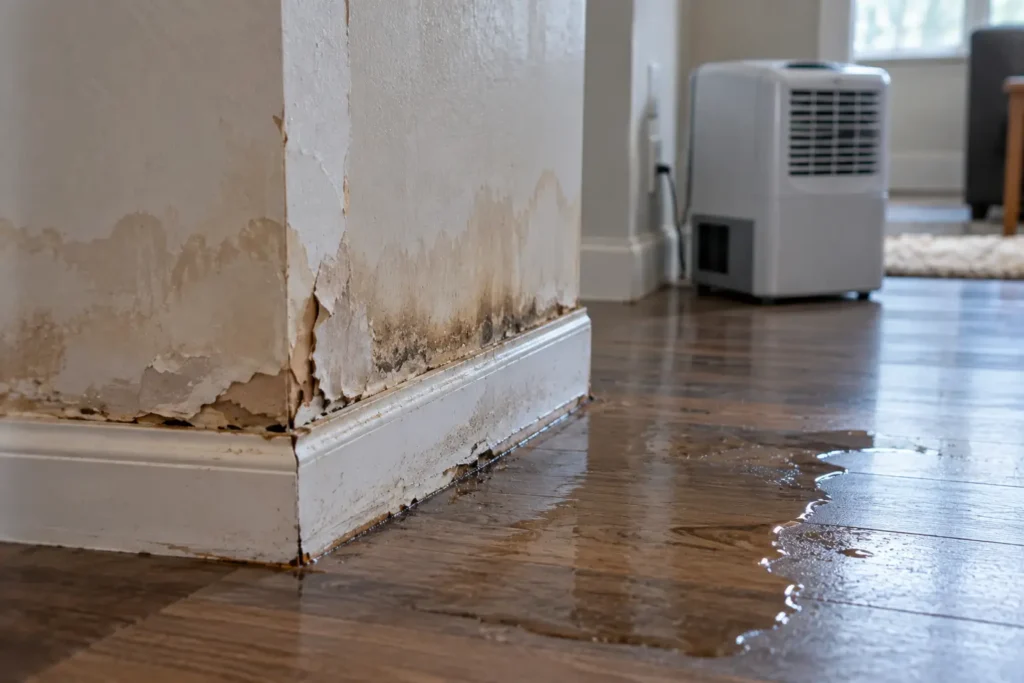
A cracked pipe often does not leak while it is frozen, because the ice itself plugs the break. The water arrives when things warm up, sometimes hours later and sometimes after you have gone to bed.
Walk the house once the temperature climbs. Look at ceilings for new stains or sagging. Check the walls under any attic access, around the water heater, and below exterior hose bibs. Listen for running water when nothing is on. Check your water meter with every tap and appliance off. If the dial keeps moving, water is going somewhere.
Wet drywall and insulation do not forgive delay. Material that stays wet for more than a day or two invites mold, which is the same slow damage covered in our post on how moisture quietly damages your home before mold ever appears. Shut the water off first, move belongings out of the wet area, and photograph everything before you clean up anything. Those photos matter when you file a claim.
Guardian Solutions works across DFW on water and storm damage restoration, and our team handles the documentation and the insurance conversation alongside the repair. If a pipe gave way, the sooner someone looks at what is behind the wall, the smaller the repair.
The fixes worth making permanent
Most of the list above is seasonal. A few jobs are worth doing once and being done with.
Replace standard hose bibs with frost-proof ones. The shutoff sits inside the warm part of the wall, so the water does not sit in the cold part of the fixture.
Have a plumber look at the pipe runs in your attic and garage. If lines can be rerouted to the conditioned side of the house or insulated properly, that work earns back its cost the first time a hard freeze arrives.
Add an accessible shut-off valve where you can reach it without a flashlight and a screwdriver. Some homeowners go further and install a leak sensor or an automatic shut-off, which turns a burst pipe into a small problem.
Confirm your irrigation freeze sensor works, and keep the foam covers somewhere you can find them in November.
One last thing worth doing today. Go outside, find your private shut-off valve, and turn it. If it moves, you are ahead of most of the neighborhood. If it will not budge, call a plumber this week instead of the night of the freeze.